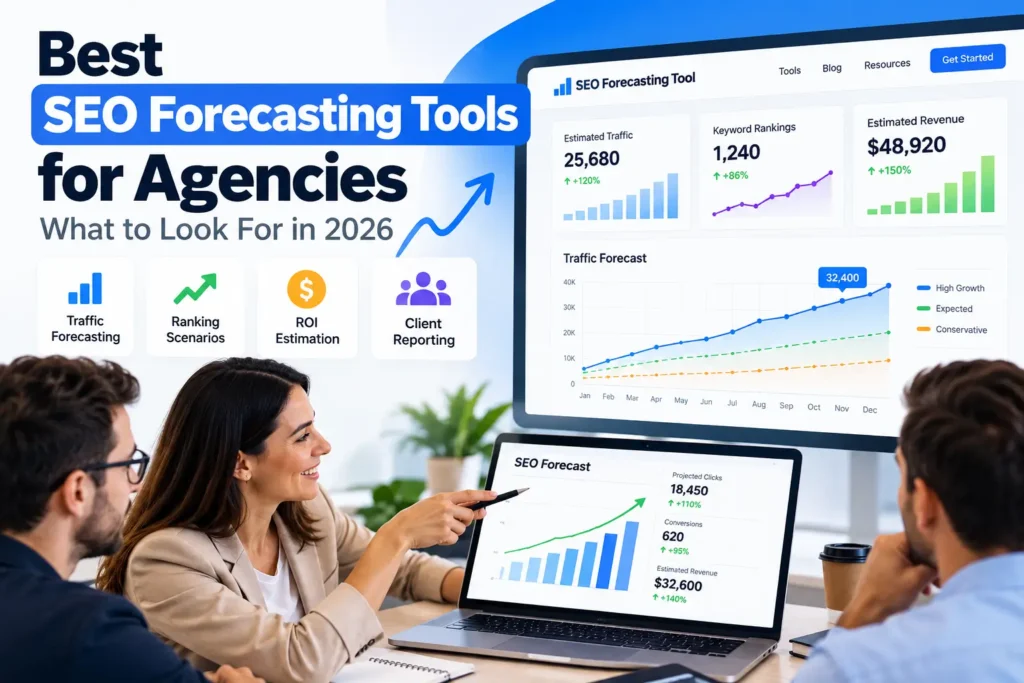
SEO agencies are often asked questions that are difficult to answer with certainty: How much organic traffic could this campaign generate? What happens if priority keywords reach page one? How much revenue could SEO contribute? And is the proposed SEO budget justified?
SEO forecasting tools help agencies turn those questions into measurable scenarios.
Instead of promising a specific ranking or traffic result, an agency can model possible outcomes using search volume, current and target rankings, expected click-through rates, conversions, revenue and historical performance.
For agencies, however, forecasting needs go beyond producing a traffic number. A useful workflow should make it easy to compare scenarios, explain assumptions to clients, connect rankings with business outcomes and revisit the forecast as real performance data becomes available.
This guide explains what agencies should look for in an SEO forecasting tool, the main forecasting approaches available, and how to build useful client forecasts.
What Is an SEO Forecasting Tool?
An SEO forecasting tool estimates possible future organic-search outcomes using a set of assumptions and available SEO data.
A basic keyword forecast might use:
Search volume × expected CTR = estimated organic traffic
For example, suppose a keyword receives approximately 10,000 searches per month. If the forecast assumes an 8% organic CTR at the target position:
10,000 × 8% = 800 estimated monthly organic visits
An agency can take the model further by including conversions:
Estimated traffic × conversion rate = estimated conversions
If those 800 visits convert at 3%:
800 × 3% = 24 estimated conversions
Revenue can then be modeled using conversion value:
Estimated conversions × average conversion value = estimated revenue
These calculations don’t guarantee future performance. Rankings change, search demand changes, SERP layouts affect CTR, and competitors continue working on their own SEO.
The purpose of forecasting is therefore to create useful planning scenarios rather than promise an exact result.
Why SEO Agencies Use Forecasting
Forecasting can be useful before an agency starts a campaign and throughout an existing engagement.
During a proposal, an agency might want to demonstrate what could happen if a client’s existing keywords moved from positions 11–20 into the top 10.
For an existing client, the agency might compare several strategies. Should the next quarter focus on keywords already near page one? Should resources go toward new content? Or could improving existing high-impression pages produce more potential traffic?
Forecasting gives these decisions a numerical framework.
It can also help agencies communicate uncertainty more clearly. Instead of telling a client that SEO will generate exactly 20,000 visits, the agency can present conservative, expected and more ambitious scenarios based on different ranking assumptions.
Agency-focused platforms such as SEOmonitor explicitly support ranking, traffic, conversion and revenue forecasting for client pitches, while AgencyAnalytics combines forecasting with ongoing agency reporting. SEOmonitor
What Should Agencies Look for in an SEO Forecasting Tool?
The right features depend on how an agency works, but several capabilities are particularly useful.
1. Keyword Traffic Forecasting
Agencies should be able to estimate how traffic might change when keyword positions improve.
The model should ideally make its assumptions understandable rather than simply returning an unexplained traffic number.
At minimum, you should know which search volumes, ranking positions and CTR assumptions are being used.
2. Ranking Scenarios
A useful forecasting workflow lets you test different target positions.
For example:
| Keyword | Search Volume | Current Position | Scenario A | Scenario B |
|---|---|---|---|---|
| Keyword A | 5,000 | 14 | 10 | 5 |
| Keyword B | 2,500 | 8 | 5 | 3 |
| Keyword C | 1,200 | 22 | 15 | 8 |
This is more useful than assuming every keyword will reach position one.
Agencies can build conservative and ambitious scenarios and explain the difference to the client.
3. CTR Modeling
Search volume isn’t the same as potential organic traffic.
The percentage of searches that become visits depends heavily on ranking position and the SERP itself.
An SEO forecasting tool should therefore apply CTR assumptions when converting search demand into potential visits.
Those assumptions should also be treated as estimates. Ads, featured snippets, AI-generated search features, local results, shopping results and other SERP elements can change actual organic CTR.
4. Conversion and Revenue Forecasting
Traffic alone doesn’t explain the business value of SEO.
For lead-generation and ecommerce clients, agencies can extend forecasts with:
- Conversion rate
- Estimated conversions
- Lead value
- Average order value
- Estimated revenue
- SEO costs
- Potential ROI
This allows the conversation to move from “How much traffic could we get?” toward “What could that traffic be worth to the business?”
5. Scenario Comparison
SEO has too many variables for a single prediction to tell the whole story.
An agency might model:
Conservative scenario: modest ranking improvements.
Base scenario: realistic targets based on current performance and competition.
Higher-growth scenario: stronger ranking improvements if the campaign performs particularly well.
Showing the assumptions behind each scenario helps prevent forecasts from being interpreted as guarantees.
6. Historical Data
Historical Google Search Console and analytics data can make forecasting more specific to an existing website.
For example, an agency can examine the site’s actual impressions, clicks, CTR, rankings and organic traffic trends rather than relying entirely on third-party estimates.
Historical data is particularly valuable for established sites.
New websites require a different approach because little or no first-party search history exists.
SEO Forecasting Tools Agencies Can Consider
There isn’t one forecasting platform that fits every agency.
Different tools solve different parts of the problem.
SEOmonitor
SEOmonitor is specifically positioned toward agencies and includes a dedicated forecasting workflow.
Agencies can model ranking improvements and translate them into traffic and business projections. Its current forecasting product also supports multiple scenarios and revenue/conversion projections. SEOmonitor
It makes the most sense when forecasting is closely connected to client proposals and ongoing SEO campaigns.
AgencyAnalytics
AgencyAnalytics approaches forecasting from an agency reporting perspective.
Its platform combines client dashboards and reporting with historical performance forecasting, making it useful when an agency wants projections alongside ongoing client reporting. AgencyAnalytics
This differs somewhat from a dedicated keyword-scenario forecasting system.
Enterprise SEO Platforms
Enterprise platforms can combine forecasting with much larger search and business datasets.
These solutions can make sense for agencies working with large organizations, thousands of pages, multiple markets or complicated reporting requirements.
They may be unnecessary for a freelancer or smaller agency that simply wants to estimate the potential impact of a keyword set.
Spreadsheets
A spreadsheet can still be a perfectly reasonable forecasting system.
An agency can import keyword data and calculate:
Search volume → target ranking → expected CTR → traffic → conversions → revenue
The advantage is control.
The disadvantage is that maintaining formulas, CTR models and multiple scenarios becomes increasingly time-consuming as the keyword set grows.
Free SEO Forecasting Calculators
For quick scenario planning, agencies can also use individual forecasting calculators rather than adopting another full SEO platform.
Our free SEO Forecasting Tool provides calculators for traffic, rankings, ROI, budget and SEO opportunity analysis without requiring an account. SEO Forecasting Tool
This approach is useful when you need a quick estimate rather than another client-management platform.
How to Create an SEO Forecast for a Client
A practical agency forecast can begin with a relatively simple process.
Step 1: Choose the Keyword Set
Start with keywords that represent the client’s actual SEO opportunity.
Avoid selecting keywords simply because they have large search volumes.
Consider relevance, current rankings, competition, search intent and whether the client has an appropriate landing page.
Step 2: Record Current Rankings
Establish the starting position for each keyword.
This creates the baseline against which your scenarios can be compared.
Step 3: Set Realistic Target Positions
Don’t automatically assume every keyword will reach positions 1–3.
A keyword currently ranking #12 might reasonably be modeled at #8, #5 and #3 under different scenarios.
A keyword sitting at #80 requires a very different assumption.
Step 4: Apply CTR Assumptions
Translate target rankings into estimated clicks using a CTR model.
For example:
Monthly search volume: 4,000
Assumed CTR: 10%
Potential monthly visits: 400
Repeat the calculation across the keyword set.
Step 5: Add Conversion Data
If the client’s organic conversion rate is known, use it to estimate potential conversions.
For example:
5,000 forecast visits × 2.5% conversion rate = 125 conversions
If historical conversion data isn’t available, clearly identify any assumed conversion rate rather than presenting it as observed client data.
Step 6: Estimate Revenue or Lead Value
Where appropriate, connect conversions with their financial value.
For ecommerce:
Conversions × average order value
For lead generation:
Leads × qualified-lead rate × close rate × customer value
This makes the assumptions behind the revenue estimate visible.
Step 7: Compare Multiple Scenarios
Create several versions instead of presenting one number as the expected future.
This helps the client understand how much the forecast changes when ranking, CTR or conversion assumptions change.
SEO Forecasting With Google Search Console
For existing clients, Google Search Console can reveal opportunities that keyword databases may miss.
Look for queries with:
- High impressions
- Positions roughly 5–20
- Low CTR
- Strong commercial relevance
- An existing relevant landing page
These queries already have Google visibility.
An agency can model what might happen if selected queries move several positions higher, then prioritize pages where the potential gain justifies the work.
This is also useful for updating forecasts after a campaign begins.
Forecasting SEO for a New Website
A new website creates a different problem: there may be little or no historical organic-search data.
In that situation, agencies can build scenarios from keyword search demand, competitor visibility, estimated CTR, content plans and ranking assumptions.
The uncertainty should be stated clearly.
Once the website begins receiving impressions and clicks in Search Console, the original assumptions can gradually be replaced with first-party performance data.
Common SEO Forecasting Mistakes
One of the easiest mistakes is treating a forecast as a promise.
SEO forecasts depend on assumptions about rankings, CTR, demand and conversion behavior. None of those variables is completely under an agency’s control.
Another mistake is treating search volume as traffic. A keyword with 10,000 monthly searches does not automatically produce 10,000 visits.
Agencies should also avoid assuming that every keyword will reach the same ranking position.
Finally, forecasts shouldn’t be created once and forgotten. As rankings, impressions, CTR and conversions change, the forecast should be compared with actual performance and updated.
SEO Forecasting Tools vs. SEO Reporting Tools
Forecasting and reporting answer different questions.
Reporting asks: What happened?
Forecasting asks: What could happen under these assumptions?
Agencies often need both.
Reporting establishes the current performance baseline. Forecasting uses that baseline, combined with assumptions about future performance, to model possible outcomes.
A reporting dashboard therefore doesn’t automatically replace a forecasting model, and a forecasting calculator doesn’t replace ongoing performance reporting.
Which SEO Forecasting Approach Should Your Agency Use?
Small agencies and freelancers may only need keyword data, Search Console, a spreadsheet and free forecasting calculators.
Agencies managing many clients may benefit from dedicated platforms that combine forecasting, rank tracking, reporting and client workflows.
Large agencies may require enterprise systems capable of handling much larger datasets.
The important question isn’t which tool has the longest feature list. It’s whether the forecasting method fits the decisions you’re trying to make and whether you can explain its assumptions to the client.
Frequently Asked Questions
What is an SEO forecasting tool?
An SEO forecasting tool models possible future organic-search results using inputs such as search volume, rankings, CTR, traffic, conversions and revenue.
Why do SEO agencies use forecasting tools?
Agencies use forecasts to evaluate opportunities, prepare proposals, compare SEO strategies, discuss campaign expectations and connect potential organic growth with business outcomes.
Can SEO forecasting predict Google rankings?
SEO forecasting can model scenarios based on assumed future rankings, but it cannot guarantee that Google will place a page at a particular position.
How accurate are SEO traffic forecasts?
Accuracy varies according to the quality of the inputs and assumptions. Search demand, rankings, CTR, competitors and SERP layouts can all change. Forecasts are better treated as planning ranges than exact predictions.
Can an agency forecast SEO without historical data?
Yes. Agencies can build scenarios using keyword demand, competitor data, CTR assumptions and target rankings. The uncertainty is greater than when reliable first-party historical data is available.
How often should an SEO forecast be updated?
Update it when enough new performance data exists to materially change the assumptions. For active campaigns, comparing forecast and actual performance during regular reporting cycles can reveal where the original model needs adjustment.
Start Building an SEO Forecast
A useful agency forecast doesn’t need to predict the future perfectly.
It needs to make the assumptions visible and help you compare realistic scenarios.
Start with the free SEO Forecasting Tool to model traffic, rankings, SEO opportunities and potential business outcomes.